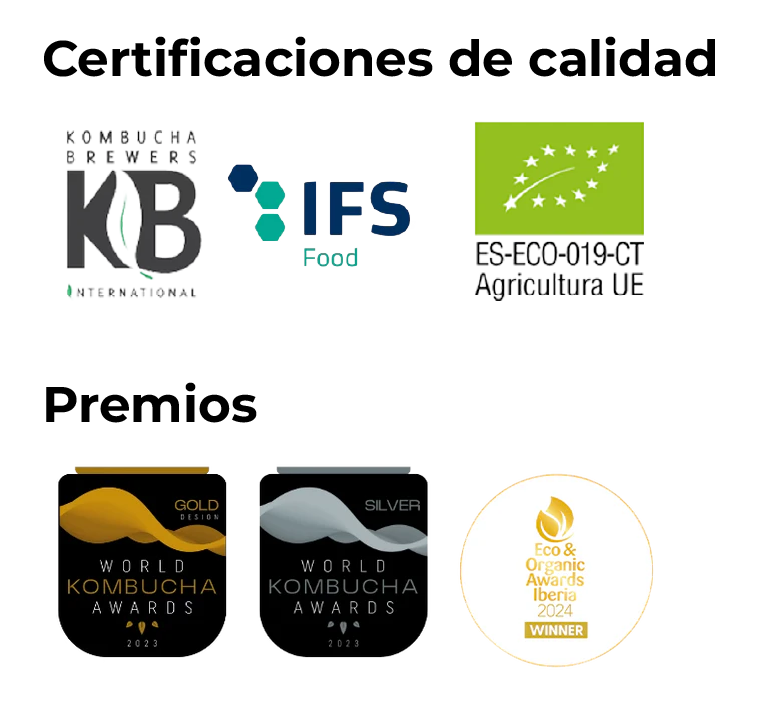

Mūn Ferments S.L. has held IFS Food certification since 2022 and, since 2023, has continuously maintained Higher Level — the maximum grade of the international food safety standard required by major European distributors.
Active Certificate

International Featured Standards · Food 8
📜 IFS Food 8 — Higher Level
- Certified Entity
- MUN FERMENTS, S.L. (IFS supplier no.: 77425)
- Certificate ID
- e651657f
- Standard
- IFS Food 8 (most recent version)
- Result
- Approved at Higher Level (Higher Level)
- Auditor
- SGS United Kingdom Limited (25)
- Audit Type
- Recertification · Unannounced
- Last Audit
- 2–3 December 2025
- Certificate Issue
- 19 January 2026
Scope of Certificate
"Production of fermented tea kombucha (tea infusion and fermentation, mixing with infusions and juices, filtration) packaged in glass bottles, cans and plastic barrels."
5 years of successful audits
Mūn began the IFS certification process in 2021. The level of demand was progressive: first an initial audit, then implementation of improvements, then the first approval at Foundation Level (2022), and since 2023, consecutive Higher Level.
- Jul 2021 Initial Audit · SGS First attempt. Not approved (expected: implementation still in progress).
- Dec 2021 Initial Audit · SGS Conditional result. Action plan pending validation.
- Feb 2022 Follow-up Audit · Foundation Level Approved First effective IFS Food certification.
- Dec 2022 Annual Recertification · Foundation Level Approved Standard confirmed.
- Nov 2023 Recertification · Higher Level Approved Achieved the maximum grade of the standard.
- Dec 2024 Recertification · Higher Level Approved Second consecutive year at Higher Level.
- Dec 2025 Unannounced Recertification · Higher Level Approved Third consecutive year at Higher Level. Surprise audit, without prior notice.
An unannounced audit means that the SGS auditor appeared at the plant without prior notice. There is no time to artificially prepare anything — protocols and documentation must be functioning on a day-to-day basis. Mūn passed the unannounced audit at Higher Level.

What is IFS Food certification
The International Featured Standards (IFS) Food is one of the most demanding food safety standards in the world. Recognised by the Global Food Safety Initiative (GFSI), it certifies that a manufacturer meets the maximum requirements for:
- Food safety — control of physical, chemical, microbiological, and allergen hazards.
- Product quality — consistency, specifications, process control.
- Legal compliance — European food regulations, labelling, traceability.
- Food safety culture — training, awareness, responsibility of the entire team.
It is not a self-certification. Each year, an accredited independent auditor spends several days at the plant verifying that every protocol is met — from the receipt of raw materials to final labelling.
Foundation Level vs Higher Level
IFS Food has two grades of approval:
- Foundation Level — meets all mandatory requirements.
- Higher Level — additionally, meets a very high percentage of optional requirements (exceeding 75% in most criteria).
Mūn has been at Higher Level since 2023, without interruption.
Why this certification matters
Major retail chains only work with suppliers who comply with IFS or BRC (its British equivalent). It is the standard filter for a brand to be sold in European supermarkets.
Distributors requiring IFS Food or equivalent:
- Mercadona
- Carrefour
- Lidl
- Aldi
- El Corte Inglés
- Veritas
- Ametller Origen
- Consum
- Bonpreu
- Alcampo
- Eroski
- Auchan
That Mūn has been at IFS Food Higher Level since 2023 means that, for 5 years, we have passed full on-site audits with a degree of compliance well above the mandatory requirements.
What IFS Food compliance entails in a kombucha factory
An authentic live (unpasteurised) tea fermentation and an industrial food safety standard like IFS might sound contradictory. They are not — but they demand discipline.
🌡️ Fermentation Control
Temperature recorded for each batch during fermentation. No need for a subsequent cold chain thanks to minimal residual sugar (0.09–1.80 g/100 ml).
🧪 Microbiological Analysis
Batches analysed by external laboratory: live probiotics, absence of pathogens, fermentation profile.
📋 Full Traceability
Each bottle can be traced back to the batch of tea, sugar, and SCOBY that originated it.
🧼 Plant Hygiene
Documented cleaning and disinfection protocols, validated with surface analyses.
🚨 Incident Management
Product recall procedure, complaint management, documented non-conformities.
👥 Team Training
Annual training plan in food safety, hygiene, and procedures for all personnel.
Why it is more demanding for unpasteurised kombucha
Most industrial beverages are pasteurised precisely because it facilitates food safety compliance — heat kills any microorganisms. But then it is no longer live kombucha.
At Mūn, we chose the more difficult path: unpasteurised kombucha + IFS Food Higher Level. This means we have to demonstrate in each audit that:
- The SCOBY microorganisms are under control (audited, identified, in expected proportions).
- There is no cross-contamination between batches.
- Fermentation reaches such a low residual sugar level that it does not allow subsequent growth of wild yeasts or pathogens. More on residual sugar control.
- The product remains safe throughout its shelf life — analysed in ageing tests.
The combination live + unpasteurised + IFS Higher Level is very rare. This is why most industrial kombucha brands opt for pasteurisation.
IFS Food vs Mūn's other certifications
Each certificate covers a different dimension:
- IFS Food 8 Higher Level (since 2023) — industrial food safety. What you are reading.
- KBI Verified Seal Program — certifies that it is authentic kombucha + live probiotics. First European brand with the seal on a bottle.
- European organic certification — certified organic agricultural ingredients.
- World Kombucha Awards — 6 medals 2023-2025, sensory quality validated by international jury.
None replaces the other. IFS guarantees that the factory meets the most demanding industrial standards. KBI guarantees that what comes out of that factory is truly kombucha. The awards verify how it tastes. The organic certification verifies the ingredients.
Frequently Asked Questions
What is "Higher Level" in IFS Food?
It is the highest grade of approval within the IFS Food standard. It involves meeting all mandatory requirements and a very high percentage (≥75% normally) of the optional criteria. A factory at Higher Level moves to a biennial rather than annual review, although Mūn continues to be audited every year.
Is IFS Food the same as ISO 22000?
Not exactly. Both are recognised food safety standards, but IFS Food is stricter in some aspects and is specifically required by major European distributors. ISO 22000 is more generic.
What does it mean for an audit to be "unannounced"?
The SGS auditor appears at the plant without prior notice. There is no room to prepare anything — protocols and documentation must be functioning under real day-to-day conditions. It is a higher level of demand than the usual announced audit.
Can a small artisanal kombucha producer have IFS?
It can, but it is very difficult. The implementation of IFS Food requires a minimum structure (several workers with defined roles, documentary systems, external laboratory) that few artisanal brands can afford. Mūn spent several years producing at an artisanal level before being able to undertake certification.
Does IFS mean kombucha is safer to drink?
All kombucha sold must comply with basic food safety regulations. IFS adds an additional layer: annual external audit, full traceability, systematic microbiological controls, documented management of every step. It is a level of demand that exceeds the legal minimum.
Can I verify this certificate?
Yes. The IFS Food 8 certificate for MUN FERMENTS, S.L. (supplier no. 77425, certificate ID e651657f, valid until 15/02/2027) can be consulted via the official IFS database or by requesting a copy from hola@munkombucha.com.
Live, unpasteurised kombucha, certified as a safe beverage
This is how we guarantee stable quality and safety in every bottle, batch after batch, since 2015.